Scratch, Scuff, Score: How to Turn Clearance-Bin Jordans Into Custom Fire
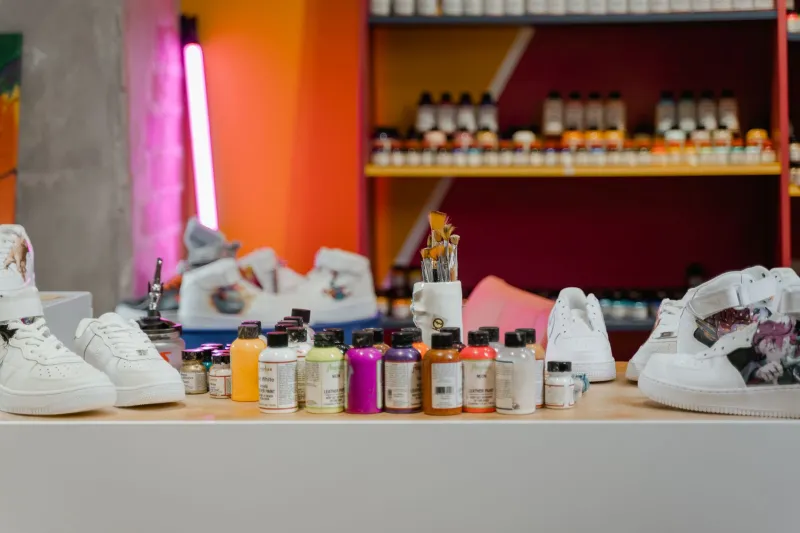
Most people walk past a scuffed-up pair of Jordans in a clearance bin and keep moving. That's understandable — nobody wants to pay even discounted money for a shoe that looks beat. But that instinct is also why damaged-retail and factory-rejected Jordans represent one of the most overlooked opportunities in budget sneaker buying.
With the right eye for damage assessment and a modest investment in materials, you can transform a clearance-bin find into something that looks completely intentional — and in some cases, better than what you'd have gotten off a standard retail shelf.
Learning to Read Damage Like a Pro
Not all damage is equal. The first skill to develop is triage: figuring out quickly whether a shoe's flaws are cosmetic or structural. Cosmetic damage is your friend. Structural damage is a hard pass.
Cosmetic damage worth considering:
- Surface scuffs on leather or synthetic uppers
- Minor paint transfer or discoloration on midsoles
- Light scratching on patent leather panels
- Small creases in the toe box from improper display storage
- Slight yellowing on clear or icy outsoles
- Loose or missing aglets on laces (easily replaced)
- Minor glue residue along the sole edge
Structural damage that makes a shoe a no-go:
- Separation between the upper and midsole (sole delamination)
- Midsole compression or cracking that affects cushioning
- Significant tears in the upper material
- Damage to the heel counter that changes the shoe's shape
- Any sign of moisture damage inside the shoe (check the insole and interior lining)
When you're standing in a clearance bin, you've got maybe 90 seconds to make this call. Flip the shoe, bend the outsole slightly to check for sole separation, press on the midsole to feel for dead cushioning, and run your thumb along the upper to gauge how deep any surface damage goes. If it passes that quick check, it's worth a closer look at the price.
Running the Numbers Before You Commit
The deal only makes sense if the math works. Here's a simple framework:
Target acquisition price: Aim for at least 40 percent below standard retail for the same shoe in clean condition. If a comparable pair in good shape sells for $120 on eBay, you want to pay $70 or less for the damaged version.
Estimated repair and customization budget: Keep this under $50 total for the project to make financial sense. We'll break down exactly how to do that below.
Wear value: Are you keeping these or flipping them? If you're keeping them, the personal value calculation is different. If you're thinking about resale, damaged-retail customs occupy a specific niche — buyers exist, but you need a compelling finished product.
A realistic example: Air Jordan 18 retro with a scuffed toe cap and some paint transfer on the midsole, found on a Nike Clearance outlet rack for $65. Standard resale for a clean pair: $130 to $150. With $35 in materials, you've got $100 into a shoe worth significantly more — and you've got something genuinely unique.
The Sub-$50 Customization Toolkit
You don't need a professional setup to do this well. Here's what actually works at an accessible price point:
Angelus Leather Paint (2-4 colors, ~$5-7 each) — The standard in sneaker customization. Flexible when dry, adheres well to leather and synthetic materials, and comes in a massive color range. This is the backbone of most beginner custom projects.
Angelus Leather Preparer & Deglazer (~$8) — Essential. This strips the factory finish off leather panels so paint adheres properly. Skip this step and your paint will peel within a week.
Angelus Acrylic Finisher (~$7) — Seals your paint job and controls the sheen level (matte, satin, or glossy). Apply this last.
Midsole cleaning kit or Magic Eraser (~$4) — For cleaning up yellowing or paint transfer on rubber midsoles before you decide whether to paint or just clean.
Fine-tip brushes and a flat brush set (~$6 at any craft store) — Don't use cheap brushes. A decent set makes a significant difference in edge work and detail.
Painter's tape (~$4) — For masking off areas you don't want painted. Worth doing carefully.
Total toolkit cost: roughly $34 to $42, with enough material left over for multiple projects.
Two Real-World Project Examples
Project 1: The Blacked-Out 18
Starting point: Air Jordan 18 retro in white/chrome with a heavily scuffed toe cap and some discoloration on the leather side panels. Purchased for $58 at a Nike Factory Store clearance event.
Approach: Rather than trying to restore the original white, lean into the damage as a design choice. Deglaze the entire upper, then paint all leather panels in flat black using Angelus Paint. Leave the woven mesh panels untouched. Clean the midsole with a Magic Eraser and apply a thin coat of white Angelus paint to restore it. Finish with a matte sealer on the leather.
Result: A blacked-out 18 that looks like a deliberate custom rather than a damaged retail pair. Total additional spend: $38. Total into the shoe: $96. Comparable customs on sites like Etsy regularly list for $200 and up.
Project 2: The Two-Tone Midsole Flip
Starting point: Air Jordan 14 retro with significant paint transfer on the midsole and a few surface scratches on the upper. Found at a Finish Line clearance rack for $72.
Approach: Clean the upper scratches with leather conditioner (often enough to minimize light surface scuffs on smooth leather). Focus the customization on the midsole: tape off the outsole and upper, then paint the midsole in a contrasting color that ties into one of the shoe's existing accent colors. A Jordan 14 in black/red getting a clean white midsole with red detailing at the sole edge looks intentional and sharp.
Result: A clean, distinctive pair that costs $110 total and looks like a deliberate colorway choice. The "damage" that dropped the price is completely invisible.
The Mindset Shift That Makes This Work
The key to this approach is releasing the idea that a shoe has to be perfect out of the box to be worth buying. Some of the most respected customs in sneaker culture started as beat pairs that someone decided to reimagine rather than discard.
Budget buyers who develop this skill set get access to a supply chain that most people walk right past — discounted pairs that other shoppers overlook because they can't see past the surface damage. With a little practice and less than fifty bucks in materials, that damage becomes the starting point for something nobody else is wearing.
That's a different kind of flex — and honestly, it hits harder than just copping what everyone else already has.